


ELEVATE is a movement to strengthen place-based evaluation and learning (PBEL) in philanthropy. A community of practice, including peer cohorts, is one lever of that movement. In 2025, we launched a seven-month pilot of the community of practice to create a meaningful experience for participants while learning in real time about what the field needs and how ELEVATE could respond. We tested different ways of learning together and regularly asked participants what was most useful. Their feedback helped us strengthen ELEVATE’s next phase.
Inside the ELEVATE Pilot
The pilot centered on Power, Legitimacy & Shared Accountability, exploring how personal and institutional positions shape who funders feel responsible to and how they define and act on success. We explored this theme through three interconnected components: Deep Dive sessions, a participant working group, and regular engagement with ELEVATE’s advisors.
Each month, pilot participants came together for a two-hour virtual Deep Dive focused on a different dimension of the theme. The sessions combined structured facilitation with relevant articles, case studies drawn from participants’ own work, and less traditional materials—including music and children’s stories—to create multiple entry points for reflection, discussion, and application.
Alongside the Deep Dives, we convened a smaller working group of pilot participants to take on a challenge that had surfaced repeatedly in our conversations: funders often use the word “community” without being clear about the specific people or groups they mean. That work led to Getting Clear About “Community” in Place-Based Learning and Evaluation, a resource designed to help funders be more precise about who they are engaging and what role those people have in evaluation and learning.

Five Lessons from the Pilot
We gathered feedback throughout the pilot and used it, alongside guidance from ELEVATE’s advisors, to shape what comes next.
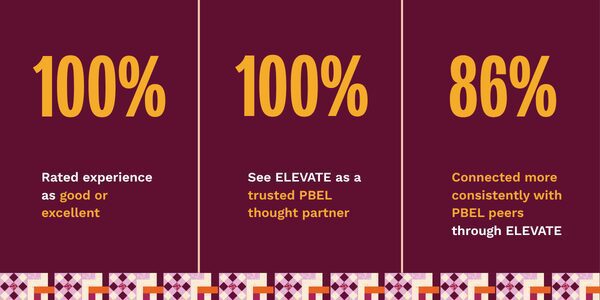
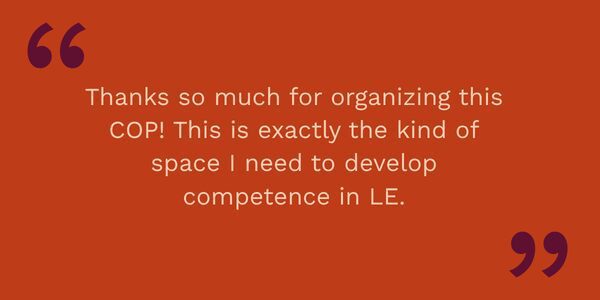
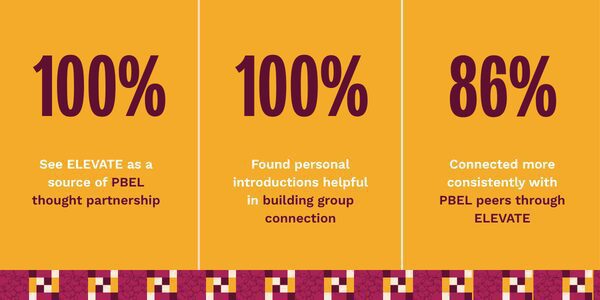
The feedback was very positive. 100% of survey respondents rated their experience as good or excellent, and 100% said they could see ELEVATE as a place to turn for PBEL thought partnership. 86% agreed that ELEVATE helped them connect with peers doing similar work more consistently than the ways they typically connected with other funders. One participant captured that value in the post-pilot survey:
Five lessons stood out and are shaping the cohort programs we’re building next.
1. Different roles need different kinds of support
The pilot brought together people with diverse responsibilities and varying types of influence over evaluation and learning within their foundations. Some were shaping their organization’s overall approach to place-based evaluation and learning, while others were closer to day-to-day management of evaluations or supporting program teams through specific learning decisions. The pilot showed that these differences affect both the kinds of challenges participants bring to ELEVATE and the kinds of support they can effectively use. The distinction is less about someone’s job title and more about their sphere of influence within their foundation.

HOW THIS SHAPED WHAT COMES NEXT
ELEVATE will launch two role-aligned cohorts that can stand alone or complement one another. The Blueprint Cohort will support people shaping their foundation’s overall approach to PBEL. The Practice Cohort will support people applying PBEL within active work. Organizations may also have participants in both cohorts, with intentional opportunities to connect what they are learning across the two experiences.

2. Learning is most useful when it helps move real work forward
One of the most encouraging findings was that participants were already taking pieces of the pilot back into their work. One participant shared, “Being part of this cohort inspired me to strengthen community-led (or grantee-led) learning and community-based sensemaking.” Another planned to use resources from the pilot to develop a learning plan template. A participant who was newer to learning and evaluation planned to revisit resources from across the pilot to continue building their knowledge.
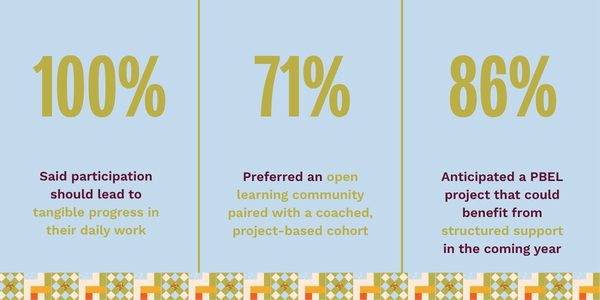
We designed the Deep Dives with application in mind, so it was exciting to see that happening. The survey showed us how much participants valued this part of the experience. 100% said it was important for participation in a PBEL community of practice to lead to tangible progress in their daily work. 71% preferred a model that paired an open learning community with a project-based cohort offering coaching and milestones. 86% expected to have a PBEL project in the coming year that could benefit from structured support.
71% of participants indicated that workload shaped their ability to participate, reinforcing the importance of making ELEVATE part of the work, not something added on top of it. That finding made us look more closely at how ELEVATE could be integrated into participants’ existing work and, where possible, reduce rather than add to their workload.

HOW THIS SHAPED WHAT COMES NEXT
Both cohorts are designed to connect directly to work participants are already responsible for. In the Practice Cohort, participants will move from shared PBEL grounding into a practicum focused on an active project, process, or task, such as strengthening an evaluation design, rethinking an RFP or consultant selection process, or testing a new approach to sensemaking. Participants will have time to identify the right focus with support from ELEVATE.
In the Blueprint Cohort, participants will bring their existing ideas, materials, and organizational context into the process. ELEVATE will take a consultative approach, helping translate that thinking into a PBEL framework participants can react to, refine, and strengthen with colleagues.

3. Most foundations represented in the pilot had not yet clearly defined and articulated their PBEL approach
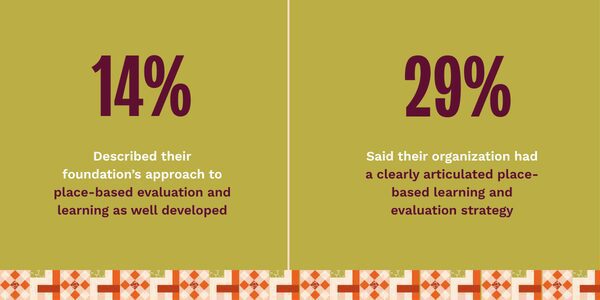
Even among participants whose foundations had years of experience with place-based work, the underlying PBEL approach was often spread across past projects or different teams. Some of it lived primarily in the knowledge of individual staff. Only 14% of respondents described their foundation’s approach to place-based evaluation and learning as well developed. Only 29% agreed that their organization had a clearly articulated strategy for their place-based learning and evaluation.
Some organizations may already have a broader evaluation and learning framework and want to clarify what that approach means specifically for work grounded in place. For foundations where all of their work is place-based, the PBEL approach may be closely connected to how the organization thinks about evaluation and learning overall. One pilot member described it this way:
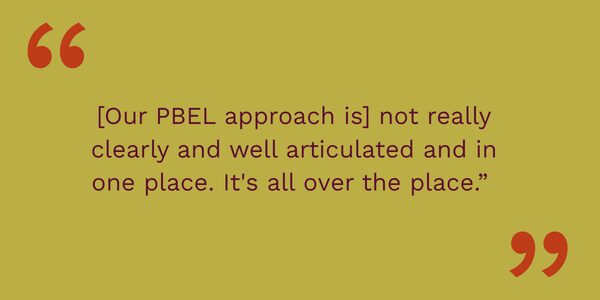
Other participants described similar experiences. One talked about digging through legacy documents after a strategy shift and significant staff turnover to understand the learning principles that had guided the organization. Another described having strong principles and examples of PBEL practice without a shared approach that brought the pieces together.
For many foundations, defining a PBEL approach starts with surfacing what already exists and deciding what should guide the organization going forward. Others are earlier in the process and need space to develop that approach.

HOW THIS SHAPED WHAT COMES NEXT
We created the Blueprint Cohort to help funders clarify and document what guides their organization’s approach to PBEL. Participants will bring their organizational knowledge and make the substantive decisions. ELEVATE will help keep the work moving by reviewing existing materials, developing drafts, and supporting conversations with colleagues where useful. The structure of the final product will be shaped around what is most useful within each organization.

4. Participants wanted more structured PBEL learning from ELEVATE
When we designed the pilot, we imagined ELEVATE primarily as a space for PBEL funders to learn with and from one another. We organized the experience around a shared learning theme and brought in resources and facilitation to support those conversations.
Through the pilot, we learned that participants also valued more structured content from ELEVATE itself. They wanted to learn more about PBEL approaches and see examples of how others were putting them into practice. They also wanted practical resources they could use in their own work. When we asked what we should strengthen for the full launch, 57% selected practical tools and templates. The same share said additional real-world examples.
Peer learning and connections were still important parts of what participants valued. The pilot helped us see that those conversations could be even more useful when people had concrete PBEL ideas and examples to react to and apply.

HOW THIS SHAPED WHAT COMES NEXT
We moved from organizing ELEVATE around one broad learning theme to developing a PBEL curriculum. We also built the ELEVATE Framework to give participants a shared set of PBEL principles to work from. Both cohorts will draw from that curriculum while giving participants space to consider what those principles and approaches look like in their own places and organizations.

5. Peer relationships need time and intentionality
Connection was a clear strength of the pilot. 86% agreed that ELEVATE helped them access PBEL peers more consistently, and 100% said they see ELEVATE as a place they would turn for PBEL thought partnership.
Some of the relationship-building practices we tested also worked especially well. 100% of respondents found the in-depth personal introductions helpful in building group connections, and 100% had a positive experience with ELEVATE’s working agreements. Those activities gave people ways to understand one another beyond their professional roles.
Participants also wanted more opportunities to deepen those relationships. 71% described themselves as somewhat connected to other pilot members, while 29% said they felt a little connected.
That feedback affirmed the direction we were already moving toward: longer-term engagement through cohorts and more opportunities to gather in person. If ELEVATE members are going to turn to one another when they are working through difficult decisions, they need more time and more ways to build relationships than a brief, primarily virtual pilot could provide.

HOW THIS SHAPED WHAT COMES NEXT
Both cohorts will begin with an in-person kickoff, include sustained learning with a smaller group of peers, and close with an in-person gathering. We will also create more informal ways to stay connected, including ELEVATE meet-ups at major conferences and ongoing connection through ELEVATE Commons, an online space where members can connect, share resources, and continue conversations between gatherings. The goal is for participants to leave with lifelong relationships they can continue drawing on as their work evolves.

What Comes Next
The pilot gave us a chance to learn with participants and strengthen the experience in real time. We are building on the facilitation and peer exchange participants valued, while weaving in an intentional curriculum and sustained opportunities to apply learning to their work.
The cohorts are one way ELEVATE will strengthen PBEL practice across the field. Alongside them, we will host field-wide convenings and events, create spaces for ongoing connection, and develop resources that share what is emerging from the work. The pilot working group gave us an early example of this through the Getting Clear About “Community” resource, which grew out of a challenge surfaced within ELEVATE and became something others could use in their own work. As the cohorts launch, we will continue capturing and publishing what we learn so that insights developed within ELEVATE can travel beyond the people participating directly in the cohorts.
Applications for ELEVATE’s inaugural cohort programs open in September 2026. Both are 22-month experiences beginning in February 2027 and culminating in November 2028. If you are curious about the cohort experience or wondering where your work might fit, join us for our upcoming ELEVATE webinar on September 2 from 2–3 p.m. ET. We will share more about the approach and leave plenty of time for questions.
Acknowledgements
ELEVATE’s 2025 pilot was shaped by the time and thoughtful participation of Amir Francois, The Annie E. Casey Foundation; Joan Marshall-Missiye, Humanity United; Robiel Abraha, Houston Endowment; Rod Martinez, The Annie E. Casey Foundation; Steph Schilling, Headwaters Foundation; and Wesley Prater, W.K. Kellogg Foundation. We are also grateful to our ELEVATE Advisors for their ongoing thought partnership throughout the pilot and as we shaped what comes next.
